[linuxadmin@localhost ~]$ vi hello_old.c
#include <stdio.h>

int main() {
    printf("Hello\n");
    return 0;
}
[linuxadmin@localhost ~]$ vi hello_new.c
#include <stdio.h>

int main() {
    printf("Hello, World!\n");
    return 0;
}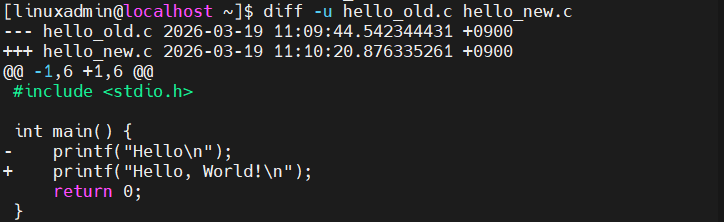
패치 파일로 만든다.
[linuxadmin@localhost ~]$ diff -u hello_old.c hello_new.c > myprogram.patch
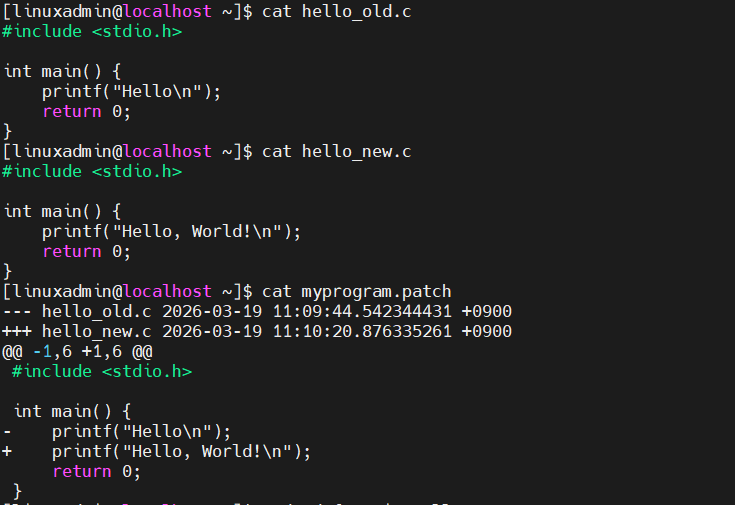
[linuxadmin@localhost ~]$ sudo dnf -y install gcc
패치 명령어 사용을 위해 패키지 설치
[linuxadmin@localhost ~]$ sudo dnf -y install patch
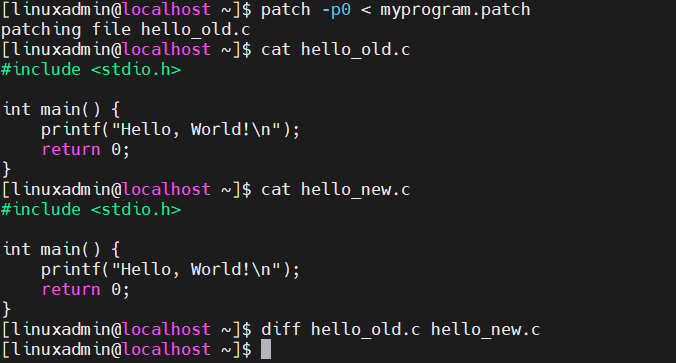
[linuxadmin@localhost ~]$ patch -p0 < myprogram.patch
- -p0 : 패치 파일 내 파일 경로를 그대로 사용하라는 의미.
- myprogram.patch 내용을 읽어서 패치에 적혀있는 파일 이름을 앞부분을 잘라내지 않고 그대로 현재 위치에서 적용하라는 의미.
'Journey to CS > C 프로그래밍' 카테고리의 다른 글
| C언어 구조체 포인터와 malloc 함수 (0) | 2026.02.25 |
|---|---|
| C언어 운영체제별로 조건부 컴파일하기 (0) | 2026.02.25 |
| C언어 3중 포인터와 문자열 배열의 메모리 구조 (0) | 2026.02.24 |
| C 언어 배열의 문자열 수정과 strcpy의 동작 원리 (+strncpy) (0) | 2026.02.24 |
| C언어 조건부 컴파일: #ifdef (0) | 2026.02.24 |